Meta Ads vs Google Ads: Which One Should Local Businesses in India Choose?
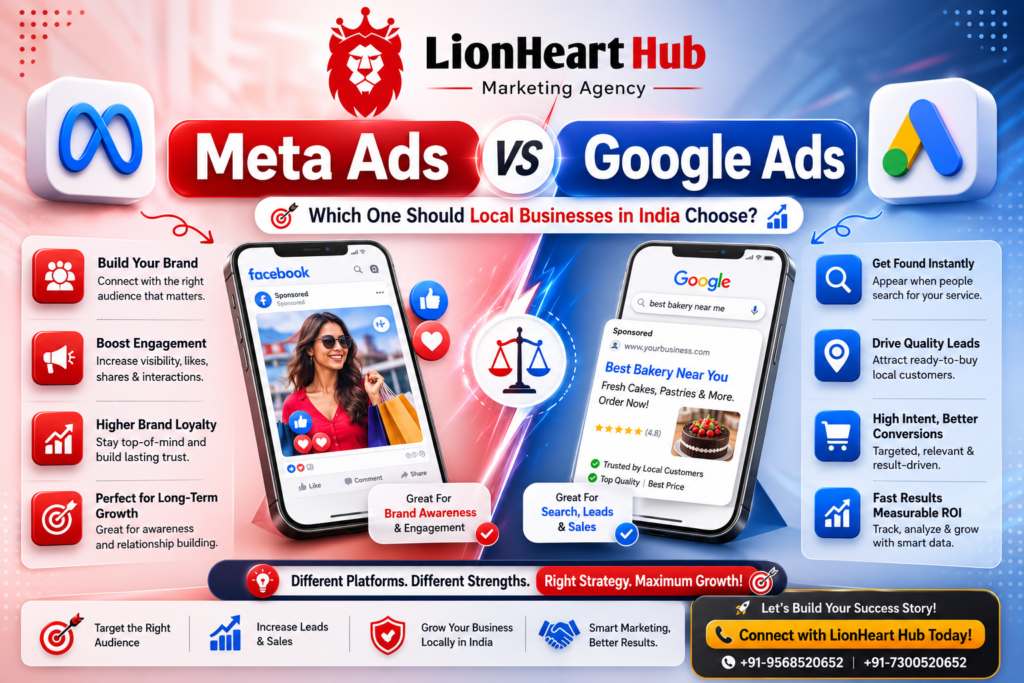
Meta Ads vs Google Ads: Which One Should Local Businesses in India Choose?
If you run a local business in India — a clinic, a boutique, a restaurant, or a home services company — you’ve probably asked yourself this question: should you put your ad budget into Meta Ads (Facebook & Instagram) or Google Ads? The honest answer is that it depends on what stage your business is at and what you’re trying to achieve. Let’s break it down.
The Core Difference
Google Ads works on intent. Someone searches “dentist near me” or “AC repair Ghaziabad,” and your ad shows up right when they’re ready to act. This makes Google Ads powerful for capturing demand that already exists.
Meta Ads works on discovery. You’re not waiting for someone to search — you’re showing up in their Instagram feed or Facebook scroll, often before they even knew they wanted your product or service. This makes Meta stronger for building awareness, retargeting website visitors, and selling visually appealing products.
For most local businesses, the real question isn’t “which one” — it’s “which one first, and how do they work together.”
When Google Ads Wins
- Service businesses with urgent need: plumbers, electricians, lawyers, doctors, car mechanics
- High-intent, low-consideration purchases: people already know what they want and are comparing options
- Local search visibility: Google Local Service Ads and Search campaigns capture “near me” searches effectively
When Meta Ads Wins
- Visual products: fashion, food, furniture, home décor
- Brand building for newer businesses with no existing search demand
- Retargeting website visitors and cart abandoners at a lower cost per click
- Younger, urban audiences who spend more time scrolling than searching
Case Study: A Local Café in Meerut
A café client wanted more footfall and online orders. They started with Google Ads targeting “cafe near me” and “best coffee shop Meerut” searches. Results were decent, but the cost per click was high because they were competing with larger food delivery platforms bidding on similar terms.
The strategy shifted: 70% of the budget moved to Meta Ads, using short-form video content (Reels) showing the café’s ambience, coffee preparation, and customer reactions, combined with location-based targeting within a 5 km radius. The remaining 30% stayed on Google Search to capture people actively searching with high intent.
Over 90 days:
- Instagram-driven walk-ins increased by roughly 3x
- Cost per acquisition dropped by nearly 40% compared to Google-only spend
- Google Ads continued converting high-intent searchers at a steady, if smaller, volume
The lesson: neither platform alone was the answer. The combination — Meta for discovery and brand recall, Google for intent capture — delivered the best return. This is the kind of blended approach agencies like LionHeart Hub typically build for local businesses instead of picking one channel by default.
Which Should You Start With?
If your business depends on people actively searching for it (repair services, clinics, legal help), start with Google Ads. If your product benefits from being seen — food, fashion, interiors, lifestyle brands — start with Meta Ads. If budget allows, running both in a complementary split, as in the case study above, usually outperforms relying on a single channel.
Frequently Asked Questions
SMO vs Performance Marketing: Which One Does Your Business Actually Need?
Business owners often ask us the same question: should we invest in Social Media Optimization (SMO) or Performance Marketing first? The honest answer is that they solve two very different problems, and understanding the difference will save you money.
What SMO Actually Does
SMO builds your brand’s long-term presence — consistent posting, community engagement, and a recognisable identity across Instagram, Facebook, LinkedIn and YouTube. It is a compounding asset: the audience and trust you build stay with your brand permanently.
What Performance Marketing Actually Does
Performance Marketing is paid, targeted advertising on Google and Meta built for immediate, measurable outcomes — leads, calls, purchases — tracked down to the rupee spent per result.
When You Need SMO First
If your brand has little to no online presence yet, jumping straight to paid ads sends cold traffic to a page with no social proof. Building a baseline presence first improves how those future ads convert.
When You Need Performance Marketing First
If you already have a strong offer and need leads or sales quickly — a new product launch, a seasonal promotion — performance marketing delivers speed that organic growth simply can’t match.
Why Most Brands Eventually Need Both
SMO builds the trust that makes your paid ads convert better, and performance marketing generates the revenue that funds continued brand building. The two are genuinely complementary, not competing strategies.
Not sure where to start? Book a free strategy call and we will map out the right sequence for your specific business.