Google My Business Optimization: The Complete Checklist for Ghaziabad & Delhi NCR Businesses
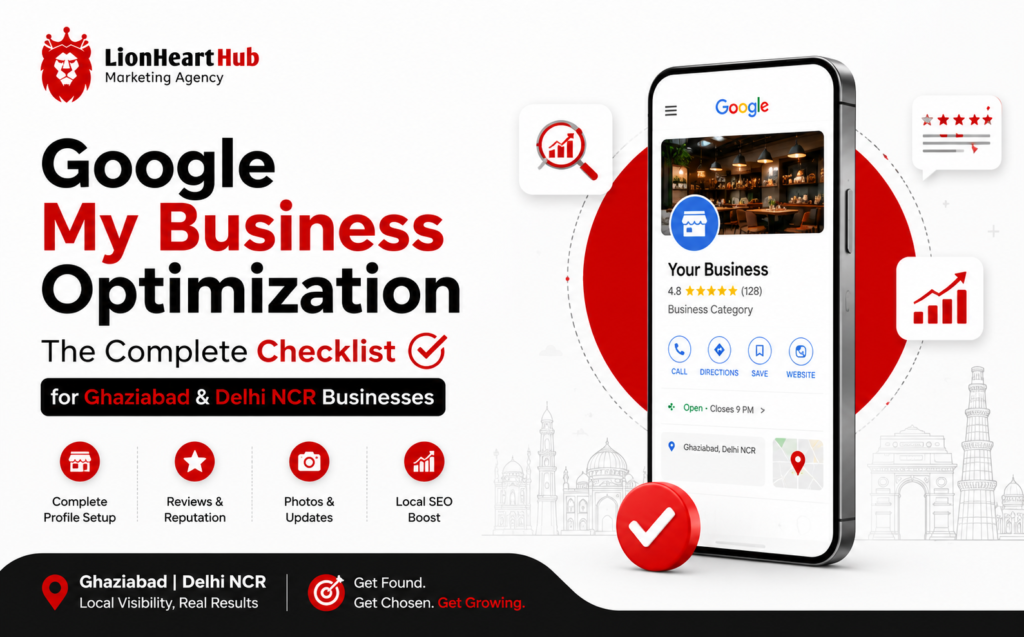
If you run a local business in Ghaziabad, Muradnagar, or anywhere in Delhi NCR, your Google Business Profile (still widely called “Google My Business” or GMB) is the single highest-leverage free marketing asset you own. A fully optimized profile can be the difference between showing up in the “Local Pack” — the map + 3-listing block Google shows above organic results — and being invisible to nearby customers actively searching for what you sell. This checklist covers every setting, field, and habit that actually moves the needle, in the order you should tackle them.
Why GMB Matters More in Delhi NCR Than Almost Anywhere Else
Delhi NCR is one of the most competitive local markets in India — dozens of businesses in the same category often sit within a 2-3 km radius of each other. When competition is this dense, Google leans heavily on proximity, relevance, and prominence to decide who gets the top 3 spots. Two of those three factors (relevance and prominence) are things you can directly influence through your profile. Businesses that ignore this hand their nearest competitors an easy win.
The Complete GMB Optimization Checklist
1. Claim and Verify Your Listing Correctly
- Search your business name on Google Maps first — duplicate or unclaimed listings are extremely common in NCR because of area/franchise confusion (e.g., multiple “branches” get auto-created).
- Verify via the method Google offers (phone, postcard, or video verification for eligible categories). Video verification has become standard for many service-area businesses.
- If you find duplicate listings, request merging or mark them permanently closed — duplicates split your reviews and confuse Google’s ranking signals.
2. Get Your NAP (Name, Address, Phone) Exactly Right
- Your business name on GMB should match your real-world signage exactly — no keyword-stuffing (e.g., “LionHeart Hub — Best SEO Company Ghaziabad” will get suspended or suppressed).
- Address must be precise enough for Google’s pin to land correctly. In areas like Muradnagar where addresses can be less standardized, use nearby landmarks in the “additional info” field, not the address line itself.
- Use a local number with the correct NCR-region code where possible, and make sure it matches the number on your website footer and Justdial/IndiaMart listings word-for-word.
3. Choose the Right Categories
- Pick the most specific primary category available (e.g., “Digital Marketing Agency” rather than just “Marketing Agency” or “Consultant”).
- Add 3-9 relevant secondary categories that reflect everything you actually do (e.g., a clinic might add “Medical Clinic,” “Doctor,” and “Family Practice Physician”).
- Category choice is one of the strongest ranking signals GMB has — get this wrong and no amount of reviews will fully compensate.
4. Write a Keyword-Aware but Natural Business Description
- Use the full 750-character description field.
- Mention your city/area naturally 2-3 times (Ghaziabad, Muradnagar, Delhi NCR) alongside your core services — avoid robotic repetition.
- Lead with what you do and who you serve, not a generic mission statement.
5. Add Complete Service and Product Listings
- List every individual service as a separate item with its own short description (this is a content-depth signal Google actively rewards).
- For product-based businesses, upload actual product listings with prices where possible.
- Update seasonal or offer-based services regularly — stale service lists are a common reason otherwise-good profiles plateau.
6. Upload Photos Consistently (and Correctly)
- Minimum starting point: 3+ logo images, 3+ cover images, and 10+ interior/exterior/team/work photos.
- Geotag photos where practical, and upload in batches over time rather than all at once — a steady cadence signals an active, real business.
- Businesses with 100+ photos consistently outperform those with under 10 in engagement metrics Google tracks (views, direction requests, calls).
7. Set Accurate Hours (Including Special Hours)
- Keep regular hours updated, and don’t forget special hours for festivals common in UP/NCR (Holi, Diwali, Eid, regional bandhs) — incorrect hours are a top driver of negative “closed when I visited” reviews.
8. Turn On Messaging and Q&A — Then Actually Monitor Them
- Enable direct messaging if you can respond within a few hours; an unanswered message thread hurts more than having messaging off.
- Seed your own Q&A section with the 5-10 questions customers actually ask (parking availability, home service radius, appointment vs walk-in) — don’t wait for the internet to fill this in for you inaccurately.
9. Build a Review Generation System
- Reviews are the single strongest local ranking factor after relevance. Volume, recency, and keyword content inside reviews all matter.
- Ask at the moment of highest satisfaction (right after service delivery, not via a delayed SMS days later).
- Send a direct Google review link via WhatsApp — NCR customers respond far better to WhatsApp requests than email.
- Respond to every review, positive or negative, within 48 hours. A thoughtful response to a negative review often reassures future customers more than the review itself hurts you.
10. Use Google Posts Weekly
- Treat Posts like a mini-social feed inside your Business Profile: offers, new services, events, behind-the-scenes updates.
- Businesses that post weekly see meaningfully higher profile engagement than those that post sporadically or not at all — this is one of the easiest wins on this entire list and the most commonly skipped.
11. Match Your Website’s Local SEO to Your GMB
- Your website should have a dedicated location/contact page with the same NAP details, an embedded Google Map, and city-specific service content — not just a generic “Contact Us” form.
- Add local business schema markup so Google can connect your website data to your GMB profile with full confidence.
12. Build Local Citations Consistently
- List your business identically on Justdial, IndiaMart, Sulekha, and industry-specific directories.
- Inconsistent NAP across these platforms is one of the most underrated reasons local rankings stall in competitive NCR markets.
Common Mistakes That Hold Ghaziabad & NCR Businesses Back
- Treating GMB as a one-time setup rather than an ongoing channel — profiles that go quiet for months lose momentum against actively managed competitors.
- Ignoring negative reviews instead of responding professionally — silence reads as indifference to both customers and Google.
- Using a virtual or shared address in dense commercial areas, which risks suspension under Google’s guidelines.
- Copying a competitor’s category and keyword strategy exactly instead of reflecting genuinely differentiated services.
Quick-Start: Your First 30 Days
- Week 1: Claim/verify, fix NAP, correct categories, write description.
- Week 2: Upload 20+ photos, list all services, set accurate hours.
- Week 3: Launch review request system, respond to all existing reviews.
- Week 4: Publish your first 2-3 Google Posts, seed the Q&A section, audit citations on Justdial/IndiaMart.
Frequently Asked Questions
Meta Ads vs Google Ads: Which One Should Local Businesses in India Choose?
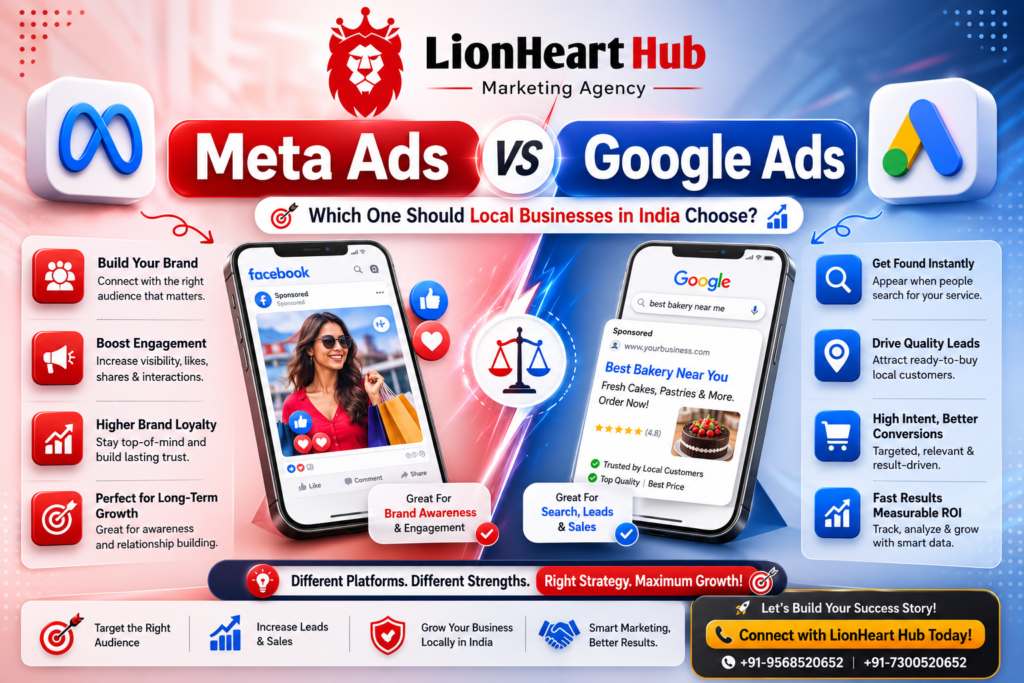
Meta Ads vs Google Ads: Which One Should Local Businesses in India Choose?
If you run a local business in India — a clinic, a boutique, a restaurant, or a home services company — you’ve probably asked yourself this question: should you put your ad budget into Meta Ads (Facebook & Instagram) or Google Ads? The honest answer is that it depends on what stage your business is at and what you’re trying to achieve. Let’s break it down.
The Core Difference
Google Ads works on intent. Someone searches “dentist near me” or “AC repair Ghaziabad,” and your ad shows up right when they’re ready to act. This makes Google Ads powerful for capturing demand that already exists.
Meta Ads works on discovery. You’re not waiting for someone to search — you’re showing up in their Instagram feed or Facebook scroll, often before they even knew they wanted your product or service. This makes Meta stronger for building awareness, retargeting website visitors, and selling visually appealing products.
For most local businesses, the real question isn’t “which one” — it’s “which one first, and how do they work together.”
When Google Ads Wins
- Service businesses with urgent need: plumbers, electricians, lawyers, doctors, car mechanics
- High-intent, low-consideration purchases: people already know what they want and are comparing options
- Local search visibility: Google Local Service Ads and Search campaigns capture “near me” searches effectively
When Meta Ads Wins
- Visual products: fashion, food, furniture, home décor
- Brand building for newer businesses with no existing search demand
- Retargeting website visitors and cart abandoners at a lower cost per click
- Younger, urban audiences who spend more time scrolling than searching
Case Study: A Local Café in Meerut
A café client wanted more footfall and online orders. They started with Google Ads targeting “cafe near me” and “best coffee shop Meerut” searches. Results were decent, but the cost per click was high because they were competing with larger food delivery platforms bidding on similar terms.
The strategy shifted: 70% of the budget moved to Meta Ads, using short-form video content (Reels) showing the café’s ambience, coffee preparation, and customer reactions, combined with location-based targeting within a 5 km radius. The remaining 30% stayed on Google Search to capture people actively searching with high intent.
Over 90 days:
- Instagram-driven walk-ins increased by roughly 3x
- Cost per acquisition dropped by nearly 40% compared to Google-only spend
- Google Ads continued converting high-intent searchers at a steady, if smaller, volume
The lesson: neither platform alone was the answer. The combination — Meta for discovery and brand recall, Google for intent capture — delivered the best return. This is the kind of blended approach agencies like LionHeart Hub typically build for local businesses instead of picking one channel by default.
Which Should You Start With?
If your business depends on people actively searching for it (repair services, clinics, legal help), start with Google Ads. If your product benefits from being seen — food, fashion, interiors, lifestyle brands — start with Meta Ads. If budget allows, running both in a complementary split, as in the case study above, usually outperforms relying on a single channel.
Frequently Asked Questions